
Purpose
Our company adopts a safe work policy under the Chain of Responsibility legislation. The transport chain includes, but is not restricted to, drivers, transport companies, packers, loaders, consignors, and receivers.
The chain of responsibility extends to any party who has control or influence in a transport operation and will be held responsible and made legally liable if found to be in breach of a transport law.
Scope
This procedure applies to all workers of our company and includes contractors, volunteers, work experience students, trainees and clients.
Policy Statement
Our company under no circumstances allows the company drivers, employees or subcontractors to place their safety of others in jeopardy because of fatigue and related effects created from unsafe work practices.
Our company supports the government’s implementation of the National Driving Hours Policy incorporated in the Transport Operations (Road Use Management – Fatigue Management) Regulation 2008.
Warning signs fatigue
Our company does not expect drivers to drive when they are fatigued. If drivers feel fatigued during a trip and they need to make an unscheduled stop for rest that will affect the estimated time of arrival (ETA), they must contact management immediately advising they will be taking a break.
Signs of fatigue are, but not limited to:
- Yawning
- Heaviness of eyes
- Dimmed vision
- Thirst and hunger
- The pressure in the head and temple area
- Painful bottom, stiffness cramps etc.
- Twitching hands
- Irritability, impatience
- Daydreaming, wandering thoughts
- Inability to maintain speed, vehicle wandering
Work Time
“Work Time” is the time spent driving a heavy vehicle and other time spent by the driver whilst undertaking a work activity including but not limited to:
- Stopped in traffic, road works or other hazard or cause
- Instructing or supervising someone to drive a heavy vehicle
- Loading or unloading a heavy vehicle
- Inspecting, servicing, attending to a heavy vehicle or load
- Cleaning or refuelling a heavy vehicle
- Recording information or completing a document in relation to the operation of a heavy vehicle
Rest Time
“Rest Time” is a period of at least 15 consecutive minutes that has no association with work at all. The driver’s minimum rest period of 6 consecutive hours in any 24 hour period and 24 consecutive hours in any 7 day period must be taken away from the vehicle unless the vehicle is fitted with an approved beeper.
Driving Hours
Unless the driver is a current registered member of the Transitional Fatigue Management Scheme TFMS the following periods will apply:
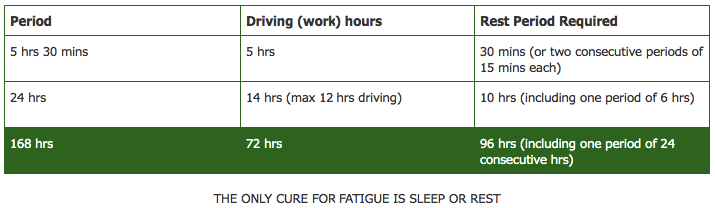
Chain of Responsibility
The National Fatigue Management Regulation places strict obligations on others within the transport chain. Penalties may be applied to consignors, employers and responsible employees that ask, direct or require a driver to undertake a task that would result in the driver committing driving hours, driver record or speeding offence if he or she complied. Refer to the Transport Operations (Road Use Management – Fatigue Management). Also, refer to Chain of Responsibility policy for more detail.
Log Books
Drivers are required by law to fill out a Daily Sheet in their log book. Drivers are also required to give the duplicate page of this sheet to their employer after each trip with their normal documentation.
The legislation states that within 21 days of completing the sheet, a driver has to give a copy of the Daily Sheet to their employer. Logbook sheets must also include all drivers’ names and particulars in the event of multiple drivers during the trip.
Our company has a policy that all drivers performing local trips MUST fill in and sign off their log book identification sheet.